Hello there, fellow human beings! Welcome to my little space on the internet. As you can see here, this is NOT the average usual left or right wing or mainstream media person's blog. In fact, I intend to not only post some of my own views, but more importantly, challenge many of the views of both the left & right, do a little occasional philosophy, promote the truth, truth people, the alternate media, & above all, the values of liberty, peace, & prosperity, in that order.
Right now, I don't have the energy or creative juices to create my own real article on this topic. So instead, I'll link to resources for people to go listen to.
I would encourage (but not require) that schools base their operating philosophy be based on the Montessori educational model, in order to facilitate the learning of individual students, embrace creativity & allow for individualism. In my opinion, if the education system truly cares for kids (which the institution of government schooling doesn't), then their enthusiasm for learning should be embraced, & be allowed to learn based on whatever their passions are in the way & environment best for them.
We sent our sons to Peninsula School. It had been founded in 1925 on Quaker and communitarian principles. The founders wrote to John Dewey to send a top disciple to run the school. Within weeks, she had her way paid back to Chicago, and the consensus became that they couldn't go far wrong if they did pretty much the opposite of the Dewey approach in every respect. They consciously instead modeled the approach after the Little Red Schoolhouse, still an extant curriculum back then.
Half of every day was devoted to recess, to play. As my old author, Brian Sutton-Smith, would explain, you can't have genius without abundant play, nor creativity, nor spontaneity, nor superior socialization skills, nor a better cure for bullying.
There were bells to mark periods, just as in the public schools, but heeding them was always optional. Or, as my oldest explained when I asked him why he let his apprentices in the movie-making biz flounder at first, "Education cannot even begin until you realize your time is your own."
What was studied in class was always up to the students, who spent the beginning and end of each day in dialogue about next steps. The students learned to speak from the heart and listen with respect. They also learned to chart their own courses (in both senses) in collaboration with each other.
There were no grades to teach that your work was for the subjective evaluation of your betters. Rather, with permission, student work was put on display, which prompted many an organic conversation. And rather than learn that your work should not be done in the expectation of material gain, student work was a huge part of the annual auction with weavings and vases selling for hundreds of dollars apiece.
There was risk. Parents were flatly told to expect broken bones. You'd see five-year-old girls walking on the limbs of the giant live oaks like they were sidewalks. Students often lunched atop Flat Top, the sixty-something foot sequoia that had been topped by lightning. Edging the Big Building was a rite of passage.
In the upper grades, there was homework but always optional. They did not presume to tread on personal time as the state does.
Unlike the tony prep private schools in the area, there was no screening of academic potential for admission. And yet two to six members of each class of 18 to 22 went on to become National Merit Scholarship Finalists each year. One year I read that six of the sixty Finalists in our area came from Peninsula, more than any other school including the hyper-academic prep schools. As a board member, I went into the office the next morning and announced that we needed to publicize that fact. I was greeted with five dropped jaws. And then my jaw dropped; I finally understood what education should be about." How is play important for child development?: ""With respect to education, we often seek to make a straight-cut ditch out of what should be a meandering brook. --Ralph Waldo Emerson"
Drive into the U-shaped driveway of Peninsula School and you are struck by huge trees and the Gilded Age mansion. Then you notice five-year old girls walking the boughs of ancient oaks fifteen feet in the air as though on a sidewalk. You hear voices above you. You look up... and up... and further up... and there sixty feet up at the top of "Flattop," the old sequoia topped by a lightning strike are three boys and a girl blithely having lunch. You hear raucous commotion and see heads racing around in a gaily-painted enclosure--the Ga Ga Court--where numerous dodge-ball, hike-ball and kick-ball games have been invented. As you approach the "Big Building," two boys race out of the doors, across the porch and, with total abandon, leap the lengthy set of front steps, landing in a sprawl. In a flash they are off again.
Around back the "shore" of the "Mud Puddle," the twenty-yard-by-eight-yard, shin-deep pond that is a fixture during the rainy season, is lined with, well, whoever wants to be there to witness the Spanish Armada (reduced to paper boats) attack England. My oldest son introduced the English fire ships. Well, not correct. They'd been there each year, but he added actual fire to the enthusiastic enjoyment of the onlookers. At 32, eighteen years later, it's still a key piece of how he defines himself.
The students at this school don't study; they play. Academics are greatly deemphasized compared with what's going on in the much sought after public and private schools there around Stanford University. Yet, after 8th grade when they move on to the local high schools, they slingshot past the other kids.
What did that look like: Half of every day was play, free play (as my old friend and author Brian Sutton-Smith liked to point out, you can't have genius without lots of play). A hand bell would be rung to note the start of class, but students were free to ignore it. There was no academic screening and academics were well down the list. The one class that used a text used a god-awful one so that students would learn to criticize what they read. Academics tended to proceed like this. Studying the Spanish Armada in 7th grade, students would assemble the Spanish and English fleets out of paper and proceed out to the mud puddle, a shin-deep pond about forty feet in diameter in the middle of the schoolyard most winters. They'd recreate the battle. My oldest is proud to this day two decades later of having added the historically-accurate embellishment of English fire ships, a tradition that has carried on ever since. Children from nursery on line the "shores" to watch the battle unfold. The presenting students weren't just learning history, they were learning to teach it in an entertaining way. But academics were secondary to crafts--pottery, weaving, jewelry, woodshop, drama, animation--as learning with the hands and mastering process (something Fichte designed out of his school) is superior for brain development and leads to greater levels of creativity. In any case, what was to occupy the class's time was entirely up to the class, and each class held a discussion beginning and end of day where what they really learned was to speak from their hearts, listen courteously and get used to charting their own destinies... with others. Once I noticed there was mysterious magic going on, I got myself elected to the board to figure out what. I finally had my Zen moment (every parent has one eventually) when I read a notice in the paper of the sixty National Merit Scholarship Finalists from the area there around Stanford, an area that features some of the most highly regarded public and private schools in the country. I saw five students who'd been in the Peninsula 8th-grade class (as far as the school went) of three years before. Well, Peninsula is tiny. Each grade is only twenty students give or take one or two. Five out of twenty is incredible given that Finalists represent the top one-half of one percent of SAT takers (I seem to recall). I had assumed we were sacrificing academics for a certain well-roundedness. I marched into the school office the next morning and asked the director and assistant director and three others there if they were aware of five students of that class having been Finalists. "No, it was six" (turns out I had not recognized one name). Someone else added, "There were two from the class before that." "And four from the class before that and three from the class before that," someone else piped in. That was incredible to me that a small student body could account for such disproportionate numbers of area Finalists--ten percent of the recent crop--and do so without academic screening or even much in the way of academics. I suggested simply, "We need to publicize this," and when I looked around the room and saw five jaws dropped, aghast, I had my Zen moment. And what makes for education and how we should go about it has never been the same for me since. How can America build its education system to become one of the best in the world? "Easy. Note every single abiding feature of our public schools and do precisely the opposite." "In short, it was a design to make sure that agency and autonomy cannot form--to make sure that students cannot grow and self-actualize. Incredibly, the majority of us embrace this most anti-human of experiments and fail to see how it is at cross purposes with our American ideal of raising fully potent sovereign citizens. Even when our most rebellious parents choose to homeschool, they adopt the same dumb-making curriculum and employ many of the same methods.
What do we do instead?
Play—You cannot have genius, self-actualization, high social skills, spontaneity, freedom from bullying, and many other desirable qualities without ample play, free play. Parking kids' butts in desks, and then labeling them ADHD should be punishable by imprisonment.
Students Sovereign—Give the students their full panoply of rights as American citizens and let them learn to flex them. Let them choose what to do with their time including not attending class. Let them set their own curriculum and goals. Let them make their own decisions and live with the consequences.
"PLAY! What is the most powerful force in all of society? The human imagination. And the crucible in which imagination forms? …play. This, by the way, is why our schools have continually limited play and kept it supervised, acting like there are better uses of students’ time. You want free play, not supervised play. And you want the full variety of play—climbing, for instance, teaches problem-solving in real time (great as a foundation for mathematics) and risk-assessment skills.
What Brian Sutton-Smith (another of my authors) called “galumphing” is the high hilarity of being totally immersed in a madcap moment. Strive to achieve it at least once a day as it floods the brain with endorphins and lays the foundation for outside-the-box thinking. Play is essential to a whole host of bodily coordination functions, some of which are critical to intellectual development.
Mastery—What turns your kids on? What do their own unique talents lead them to? As you detect them find your kids arenas to try them out. If your child heads off to college with 5000 or even 2000 hours toward mastery in whatever area, they already have an “unfair” advantage in life. Be more concerned about what your child is drawn to and wants to stick with than your adult evaluation of how lucrative or intellectual or esteemed the field is—there are lots of nuanced layers to sussing out mastery.
Mentors—The best arenas involve mentors who have those same skills. We’d send the boys off for six, eight, twelve weeks at a time to be mentored. We laid no ground rules or conditions; we wanted them to experience differing forms of adult authority. But mostly we wanted them getting deep experience from successful people in the area they seem to be headed to. “Micro” mentors and tutors for just an hour or three a week help too. This worked gangbusters for us.
Travel—By age twelve, we wanted the boys out in the world away from us for extended periods under the supervision of other adult mentors. By age 15, we wanted them in foreign countries. There’s no more real-world experience than having to adapt to new places, new household rules, new cultures, new languages.
Adventure—My business partner and I would take our sons, starting at age 12, deep into the Grand Canyon well beyond other hikers and with no contact with the outside world. The oldest got his skin-diving certification, the youngest sky-diving lessons. Such experiences build resourcefulness and are incredible confidence-builders.
And, in general, take every one of Fichte’s goals and shred it. Make their time their own. (Our oldest states with the young people he now mentors, “Education does not even start until you realize your time is your own.”) Never pass up a quality program or opportunity in sports, music, acting and improv, public speaking, intelligent conversation, caring for others, making things, doing things, letting hands and brain function together.
Do not micro-manage this process. Do not be a hover parent. Let them own it; that’s the only way it can work.
To answer the question, I have no idea why people default to saying the things they say. I do know it’s important to get your children real-world skills, and I do think the above ideas are part of the way to go about it. I also strongly suspect that keeping them out of schools these days is a great step in the right direction."
Play--According to my old friend Brian Sutton-Smith, it's difficult to foster genius without abundant play, which also promotes spontaneity, social-integration skills, confidence and more.
Crafts--Students have been right all along, we don't teach useful subjects. Processes taught start-to-finish are essential to competence and to the kind of brain skills that lead to cross-over thinking (weaving is outstanding for teaching mathematics, etc.)
Mastery--At present, schools actually interfere with students getting a head start on the proverbial 10,000 hours it takes to achieve mastery of a discipline.
Real World Interaction--No more hermetically-sealed isolation from the real world.
Listening and Speaking--No skills get people further ahead in life than being able to speak from the heart and being able to listen with respect and comprehension."
The school we sent our sons to, Peninsula School in Menlo Park, California, had an interesting history. Founded by Quaker labor organizers in 1925, their first thought was to write to John Dewey in Chicago offering to hire one of his top graduates. Only two weeks after her arrival, they paid her way back to Chicago and decided they could not go far wrong if they did the exact opposite of the Dewey method in every respect.
So impressed was I with the school’s impact on children, I took a seat on the board the better to figure out what was going on. The following flows from my experiences at Peninsula extended a bit to cover what my ideal education system would look like.
Purpose. Rather than pretend to prepare kids for the real world by keeping them hermetically sealed from it, provide abundant real-world experience including mentorships and apprenticeships outside of school. Use extended field trips.
Citizenship. Rather than school being a special environment in which children do not get to enjoy their robust American rights, make a major point of the school using and becoming familiar with their rights and respecting the rights of others.
Location. Rather than base schooling in the bureaucratic public sector with its “one size fits all” approach, put it back in the private (for-profit) and civil (not-for-profit) sectors where innovation and catering to specific markets and needs can occur.
Academics. Rather than devote the bulk of the time to memorization of idle facts, prefer the teaching of processes start to finish. Engaging the mind and hands together provides knowledge that lasts a lifetime, unlike fleeting memorization.
Time. Rather than using bells and schedules to teach students that their time is not their own, let students own their time and be free to pursue activities they prefer.
Grades. Rather than the insincerity of passing subjective judgment on student work, put student work on display leading to discussions of students’ ideas.
Pedagogy. Rather than “the sage on the stage,” teach students control of their own lives by letting class discussion determine curriculum. Teachers should be more “the guide by the side.”
Play. Rather than long days of structured activity with even play adult-directed, allow for abundant free play.
Skill-base. Rather than ignore all-important listening and speaking skills, use class discussion purposively to resolve issues, plan, come up with ideas and so on.
Private time. Rather than campuses designed so that there is no place to escape scrutiny, allow ample places for students to gather in private or alone.
Conflict resolution. Rather than discipline flowing top-down from authority figure to student(s), have students resolve all issues directly themselves.
Duration. Rather than school starting young and lasting until adulthood, have it be optional and voluntary at all times.
Curriculum. Rather than pre-digested study materials and canned “experiments,” have students engage in realistic projects with uncertain outcomes so that they learn to cope with ambiguity, uncertainty and failure.
Engagement. Rather than each class be an island unto itself, arrange activities for age mixing in meaningful ways. Have older students mentor younger ones.
Seating. Rather than ranks and files of desks, use tables around which smaller classes can easily see and engage their classmates.
Ambiance. Rather than sterile institutional appearance, have schools that students can add to themselves, paint murals, adapt to needs, carve their names and so on.
Peninsula produced graduates who were self-assured, self-actualized, skilled, with a good start toward mastery of a discipline and well-versed at employing their rights. To me, this is education." Yet another philosophy would be Elon Musk's educational philosophy, which he claims is so good that his kids actually want to get back from vacation to the school that he was created.
While reading on Wikipedia, I've read some criticisms of unschooling/home education. While these are far from the only criticisms, & nor are they particularly deep or detailed, they are common in arguments against unschooling/home education. I'll have to adress others on a case-by-case basis.
"Socialization. Schools provide a ready-made group of peers, but unschooled children need other ways to make friends in their age group." This is highly questionable. I've heard. Also, unschooling can involve group activities such as field trips. Forced socialization can also create problems. Maybe a reason why bullying occurs & why kids hate school is because they are outright forced to socialise, sometimes with bullies or people they otherwise would have avoided. "Isolation. A child might not encounter people of other cultures, worldviews, and socioeconomic groups if they are not enrolled in a school. Of course, a school is not necessarily a place that is guaranteed to provide such a range of experiences, either." This argument really shoots itself in the foot with the last sentence. How does being confined to a building & well within the surrounding area for several hours a day for most of the week & then being made to do busywork (homework) to eventually be allowed out not at least somewhat isolating? "Qualifications. Some parents may not have the skills required to guide and advise their children in life skills or help them pursue their own interests." "Development. Children won't learn what they need to know in their adult lives." This is nonsense. Boyinaband has already done a video articulating being made to learn information in school that most people probably will not use again in their lives.
StormCloudsGathering's "Truth About School" & Ryan Dawson's videos about school has similarly gone into detail but from a more political perspective.
Most schools already teach little that is important or useful to students. And many students know it, but few articulate it well.
Some parents are better at teaching their kids than others. The exact same goes for teachers. The exact same goes for surgeons. And the exact same goes for every occupation. At least parents have real skin in the game to properly educate their child. While I'm sure that most teachers are well-meaning, there is also a significant number who teach simply to have control over others (I know that type) &/or to get a stable (government) paycheck. Qualifications? The East German Trabant was probably designed by qualified planners. And it goes down as one of the worst automobiles in history (especially for a German automobile). And Elon Musk (& some other successful individuals) can care less rather or not you have a college degree.
"Standardization. A child may not learn the same things a regular-schooling peer does unless an educational professional controls what material is covered. In a 2006 study of five- to ten-year-olds, unschooling children scored below traditionally schooled children in 4 of 7 studied categories, and significantly below structured homeschoolers in all 7 studied categories." Why do we need standardization? People are not inanimate objects like, say, cars (& there are many types of cars at that). We all have different interests & passions, different levels of motivation, different styles of learning, different ways of living, different dreams in life, different personalities, & so on & so forth. We are all different. Why do we need to be standardized cookie-cutter style? Why should someone looking to get into business be forced to learn astronomy, or someone looking to get into astronomy be forced to learn about business (that was paraphrased from some video in my school & education playlist)?
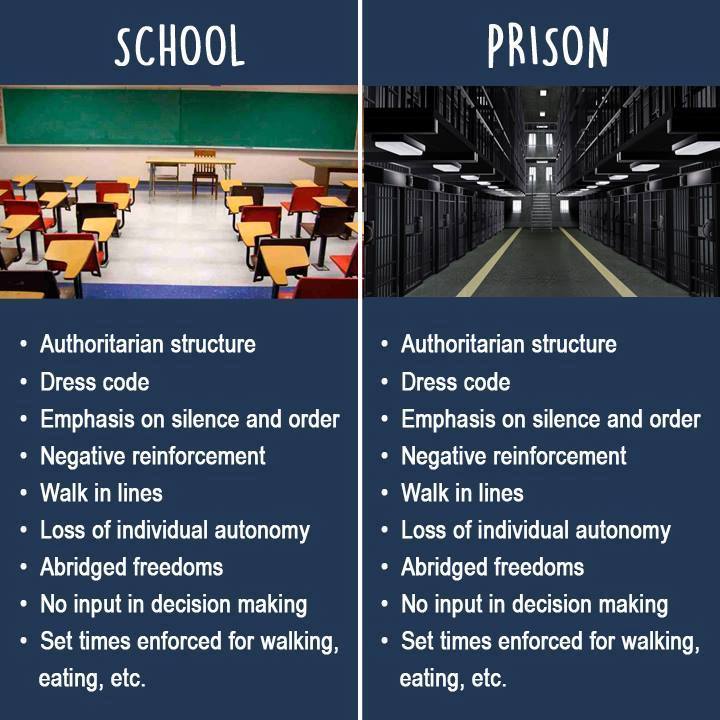
You are made to go in at a specified time. You are made to sit down at desks in nice & neat rows. You are made to do work which is to be completed at a specified time, & the quality of that work must be up to a specified level. A bell like that in a factory (which may also be a stand-in for military commands) rings to signal changing to other work types, with set times to do everything. It is common to walk in straight lines. To go with all of this at the same time, there is a mandatory dress code, negative reinforcement, rules that fail to fully respect our real constitutional rights (particularly with zero-tolerance & restrictions on free speech/expression), an authoritarian structure with little to no real input in decision making, & there is emphasis on silence, order, & most of all, obedience. And all of that is before you are made to do homework. No wonder why kids hate school so much, & feel like it is a factory prison.
I'll explain why schools are ran like this later.
How do we fix this?
My idea is to, first of all, be permissive to home education & encourage it. This is to provide maximum individualization of education, to give maximum respect to the rights of individuals & their families. Even PrinceEa supports individualizing education.
(The video directly below is the most important video here, condensing the origins, problems & solutions with education/school into a 45 minute talk.)
I'm sure that someone will say something along the lines of "What if not everyone can afford home education", or "What if there are not enough teachers for every kid?", & as a pragmatic person, if that is a problem, I have a solution to that type of problem as well. Second of all, convert all public, or should I say, government schools into smaller, decentralized charter schools, & combine that with school choice. This is so people are no longer bound by geography when it comes to schools, so it no longer matters rather a person is rich & living in the most affluent part of town, or poor & living in the worst part of town; people from both situations have the same opportunity to go to the same school. And school choice would both force schools to both raise standards to compete for students & allow for different educational philosophies. I have yet seen a study or statistic piece, or other facts or evidence to disprove of school choice. No amount of mental gymnastics or sophistry will change facts & evidence. Not to mention how, according to one firm, about 75% of millennials support school choice, & according to the Democratic polling firm, Beck research, about 63% of likely 2018 voters support school choice. Shorter videos (with importance being least to greatest):
The origins of today's government schooling system actually came from Prussia to create more obedient workers & military personnel, with other European monarchies also using forced schooling for the same reason.
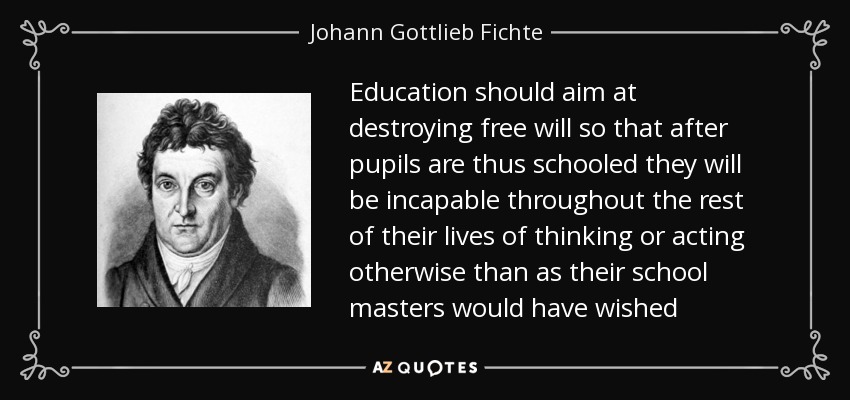
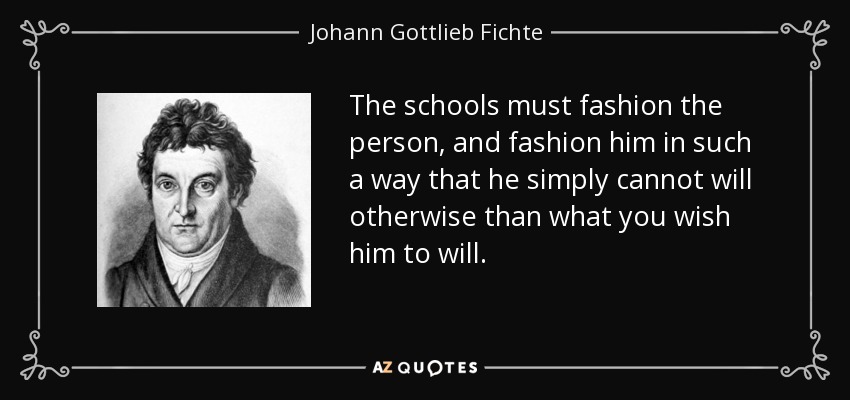
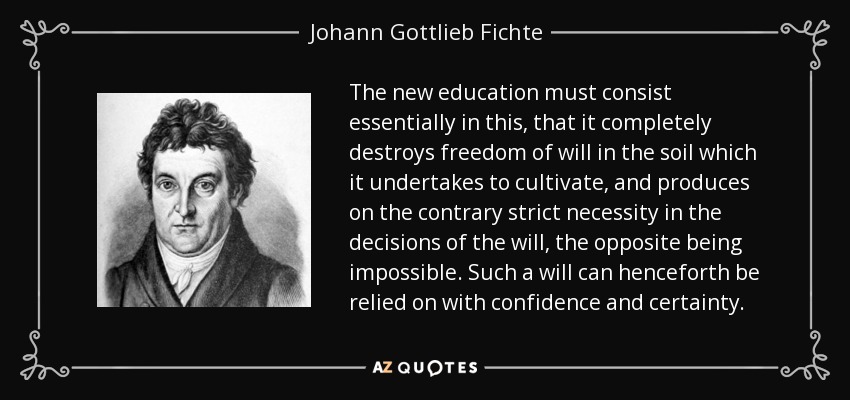
Don't take my word for it. Ask Johann Gottlieb Fichte, the creator of the Prussian Schooling philosophy (straight from the horse's mouth!).
Much of what I just stated about the Prussian school model can be found on Wikipedia (a site that is NOT friendly to conspiracy-theories), so you do not need to completely take my word for it. My beef with both liberals & conservatives: I find it sad that the same supposed liberals who support forced government schooling & love up so much on Horace Mann actually support a system that is fascist (if not authoritarian) & goes against supposedly liberal values such as individualism & peace, not to mention how schools were made in industrial revolution era Prussia to condition people to be obedient workers & military personnel, & today, is still conditioning people to work for the exact same military that works for the corrupt government & the exact same corporations that many liberals supposedly hate. Not to mention how there were industrialists (Rockefeller, J.P. Morgan, Carnegie, Ford, & more) who wanted government schools with a design that is expressly intended to create obedient workers. Is that really what liberalism & progressivism supposed to bring? For more details about schooling & peace, read the article How Schooling Leads to War.
Now, here's Quora writer Dennis Pratt's answer to the Quora question Why are schools politically liberal?: "A Different Master For The Schools Imagine that the NRA had the political power to “school” our children. - The NRA opened NRA schools in every town. - The NRA compelled our children to attend their NRA schools. - The NRA forced taxpayers to pay for them. - The NRA created the curriculum for teacher colleges. - The NRA decided the requirements for teachers to graduate. - The NRA selected which teachers went where. - The NRA decided promotions and raises. - The NRA decided the curriculum for our children. - The NRA decided what should be in the texts. - The NRA required students to pledge allegiance to the NRA every morning. - The NRA posted pictures of past NRA presidents in every classroom. - The NRA gave days off to celebrate NRA holidays. - The NRA regularly had NRA speakers at the school. - The schools tracked NRA news. - Every student took heavy doses of NRA Civics. - Every student learned about the important role that the NRA plays in protecting our freedoms. - The students memorized the cities in each state where the NRA had its state headquarters. - Human history was taught through the scope? of guns - Essay questions often ended with, “Describe how guns could solve this problem.” What Result Would We Expect?
Would we be surprised to find all schools generally pro-guns? Would we be surprised to find graduates of their schools with major gun purchases and with lots of practice firing? Would we be surprised to hear the next generation talk to us passionately about the importance of guns in our life? Whose pictures would an NRA school display for revering?
So When Government Does This Today, What Should We Expect?
When schools are owned and run by the government, on government property, paid for by the government, staffed by government workers, overseen by government, and we have no say in whether our child or our money goes to them, we should not be surprised that they rationalize government control over our lives." We expect that religious schools will indoctrinate their religion.
Government is just another religion. Yet we act confused when we see government schools producing wave upon wave of pro-government drones. It’s almost like our brains had been programmed not to see a connection. (I wonder when that might have happened.….) That government schools teach allegiance to the government was no surprise in Sparta, where young boys were taken from their parents and raised in Spartan schools to be fully indoctrinated as warriors for the Spartan state. It was not a surprise when Prussia reinstituted government schooling on the Spartan model, because Prussia was tired of losing wars and wanted to instill blind obedience to the Prussian state. (Just a few decades after the introduction of Spartan schooling into Prussia, tens of millions of young men were willing to become obedient cannon fodder for their Fatherland, enabling the carnage of both WWI and WWII.)
And it was this Spartan-Prussian model that Horace Mann consciously brought over to America to impose on our children: I get the most sad when I hear people saying that we need government schools to “teach our children about freedom”. There cannot be two concepts further apart. And yet, somehow people schooled in government schools parrot it back. I wonder how that happened?" Here's a comment that he made: The same mechanism would be used to make schools politically conservative. I think I was talking only about the mechanism, and not how liberals, in many instances, won control of the mechanism. I’ll have to take your comment under advisement. The mechanism of government-imposed, government-run indoctrination camps is available to any authoritarian. Look at the conservative method that Sparta and Prussia used it — to create drone armies happy to die for their leader. Perhaps it is that in the US, liberals are much more authoritarian than conservatives. I was actually playing around with some political grids, and the old school fundamentalists are much less powerful today. However, there are places (e.g, in the south) where the same mechanism is actively used by the local fundamental conservatives for the analogous outcome. There the question would have to be, “Why are schools politically conservative?” I had a revelation one trip around the South. I came upon group after group of liberals who were so angry that their schools were politically fundamentalist conservative. I thought that I had an in-road to talk about freedom of choice in schooling — allowing lots of alternatives and parents choosing the best school for their child and their family (always based on their values.) Of course, this would allow these liberal minorities to have a choice for their child which matches their values. However, and this was the eye-opener for me, the liberals rejected freedom of choice. Instead, they were bound and determined to capture the indoctrination mechanism themselves in order to “save” the children from the values of the children’s parents. Just so you know, I had a similar result in conservative minority communities who were upset by overwhelming liberal schools!! They seemed to be less interested in “a thousand lights” than they were in making sure all the lights were red, or blue, or whichever color they wanted everyone else to be. The mechanism is effective, and that’s why we have these great battles over who should control the school experience of my child and of your child. My solution is to allow many different types of schools such that no sub community feels oppressed, but I fear that many people want to oppress. Government run schools are the perfect mechanism. :(" And another comment: "I find it amazing, Barbara, that the people who are supposed to be teaching our children how to take their place in (what is a business) world, cannot solve the problem faced by every single company, (and by every one of their teeny tiny competitors battling the big monopolists). The only solution that they can come up with is using threats of violence to get their money — artificially keeping out alternatives and forcing parents to pay even when they don’t want the service? Let’s be glad that a few of the graduates of those schools were able to figure out what seems to be such an intractable problem for government bureaucrats! If they can’t figure out such a common invariable cost problem, how can we ever expect them to solve the demand problem of serving customers so much better that they don’t want to escape?" Schooling and Indoctrination: "Libertarians are quite concerned with government’s intrusion into the raising of our children. Authoritarians see our rulers as being kind, helpful, and concerned for our children’s welfare Libertarians see instead indoctrination, separation from the family and its values, submission to state authority, bullying, monopolization, crushing children into one-size-fits-few schooling, and inculcation into anti-wealth creation and pro-wealth confiscation. A libertarian society would allow any entrepreneur to open up any type of school. It would allow families to select whichever schools they preferred for their individual child. Fees would be negotiated between parents, schools, and, if needed, voluntary charities and private financing. There would be a far greater diversity of schooling approaches that better matched the diversity of children. Rulers would be kept as far away from our children as possible."
Please don't bother using the Argument from Moderation fallacy.
"Truth is truth, even if no one believes it. A lie is a lie, even if everyone believes it" - Anonymous. I've seen liberals who don't like public schools being referred to as government schools, as if to make the concept sound better. But let's look at the reality; "The building you're sitting in was built by, & owned by, the government. All of the people who work in this building, from the teachers to the custodians from the coaches to the front office staff, all of these people work for the government. They're government employees. Their paychecks are written by government. The people who decide what you will steady every day, they're government employees. The people who decide what textbooks you'll use. They're government employees. And it is the government that compels your attendance. These schools then are owned, operated, & staffed by government. So... they're government schools!" - Yankee Prepper.
I also find it sad that supposed conservatives (& some libertarians, from reading through comments sections on the internet) talk all the time about freedom of speech, expression, & being politically incorrect, but do not object to school dress codes & some even support school uniforms. Gonzales High School in Texas that even offers students who violate the dress code the option to wear jumpsuits as an alternate punishment (at least there is limited choice in the manner). Conservatives (& libertarians) talk all the time about government overreach & lack of respect for the constitution. It seems that many do not realize that kids going to school is not just reading them to go to work, but rather, conditioning them for life. So few conservatives talk about how prison-like school is & many do not speak out against arbitrary rules & punishments. With such an authoritarian institution like school (especially with strict rules of many schools in Texas), what do they expect? And in actuality, schooling has helped ruin entrepreneurial spirit & create generation snowflake, people who are scared of the real world. Essentially, students get validation through virtue, which is shown through obedience, which fosters intellectual & emotional dependency. Hence, why we have virtue signalling, with people seeking external validation instead of self-actualizing, leading to collectivism, the group mentality, & virtue signalling. For example, when someone talks about a low-brow, safe topic such as how much they hate racism, that comes from them seeking external validation, to be socially accepted. This is all talked about in the video below from 50:51 to 1:02:48.
If you want some conservative sources about how schools are like prisons, here's some examples from John Whitehead of the Rutherford Institute. Infowars also has commented on the issue.
I'm sure that someone would say something along the lines of "By attending school, you agree to its policies" or "Students & their parents sign a contract stating that they agree to the school's policies", almost as if it is a choice as to rather or not to obey school policies. This is not a true choice, considering how if a kid fails to attend school at a government specified time, they &/or their parents would be arrested, & disobeying school policies would get said kid in trouble, all the while neither the kid nor their parents had a choice in which school the kid goes to & the family does not have enough money to send move or send the kid to a private school or home educate the kid. This is little different from an organized crime forcing businesses into paying money for "protection racket". The video below articulates this type of issue better.
And both mainstream sides are still in the old school paradigm, still trying to measure "success" by standardized tests, which in reality, do NOT measure success.
By the way, I'd like to mention a few things that I've read about the Montessori educational philosophy. In 1936, Montessori said "Preventing conflicts is the work of politics; establishing peace is the work of education", & has written a book called Education And Peace.
It's also been said that Montessori was not liked by the Italian Fascist regime because she is interested in developing unique individuals instead of people who are simply followers.


 Posts
Posts